The other day I went to Google with a question that I had been thinking about: How does a radio work? Apparently this is a fairly common thing to ask, as there were over three billion results.
 For context, that’s close to the amount of results that there are for “apple”
I wasn’t looking for anything particularly detailed; I just wanted something that could both explain and show the basic concepts behind the technology.
My goal was to go from my virtually zero knowledge on radio (and radio waves) to being able to look at a basic radio and think, “Yeah, I get it”.
So, with 3 billion results in front of me, I started combing through pages of Google for learning resources directed towards beginners, hoping that such a commonly asked question would have some stand out answers.
Instead, most of what I found could fit into one of three categories:
- Not Enough Detail: Most of the resources in this category would just say something like: “electromagnetic waves carry information from a transmitter to a receiver while travelling through the air,” while showing a fancy diagram and never expanding on what was said.
- The value of this type of resource is extremely limited. At its best, it provides a superficial level of understanding.
- You could make the argument that this type of content is aimed at children, but so are Bill Nye videos which still manage to explain concepts in a practical sense at an introductory level.
- This is the most common issue in my experience– most likely due to it being easy to produce quickly, and easy to share (💰💰💰).
- Assumed Experience: This is when the resource assumes that the reader (or watcher) already knows the terminology and the basic math behind what it’s explaining. This is highly subjective, and isn’t necessarily a bad thing. In fact, many of the resources I found that were too complicated for me at the time I saved and came back to later after learning some more.
- It can be annoying as a beginner to see someone jump from talking about what touching two wires together does, to formulas with more Greek characters than numbers.
- It isn’t bad have advanced concepts, but they should be explained (or at the bare minimum, have explanations linked to).
- Too theoretical: Especially as a beginner in the subject, it can be extremely difficult to understand something if it’s only described conceptually or through high-level diagrams. With radios, it’s normal for waves to be represented via a sine wave, which while are great for understanding concepts like frequency and wavelength, fall short when attempting to visualize how waves actually move, especially when compared to a diagram in a heatmap-like form
- This isn’t to say theory isn’t important, however, there is a point where it needs to be backed up by real-life examples (or something relatively close to it).
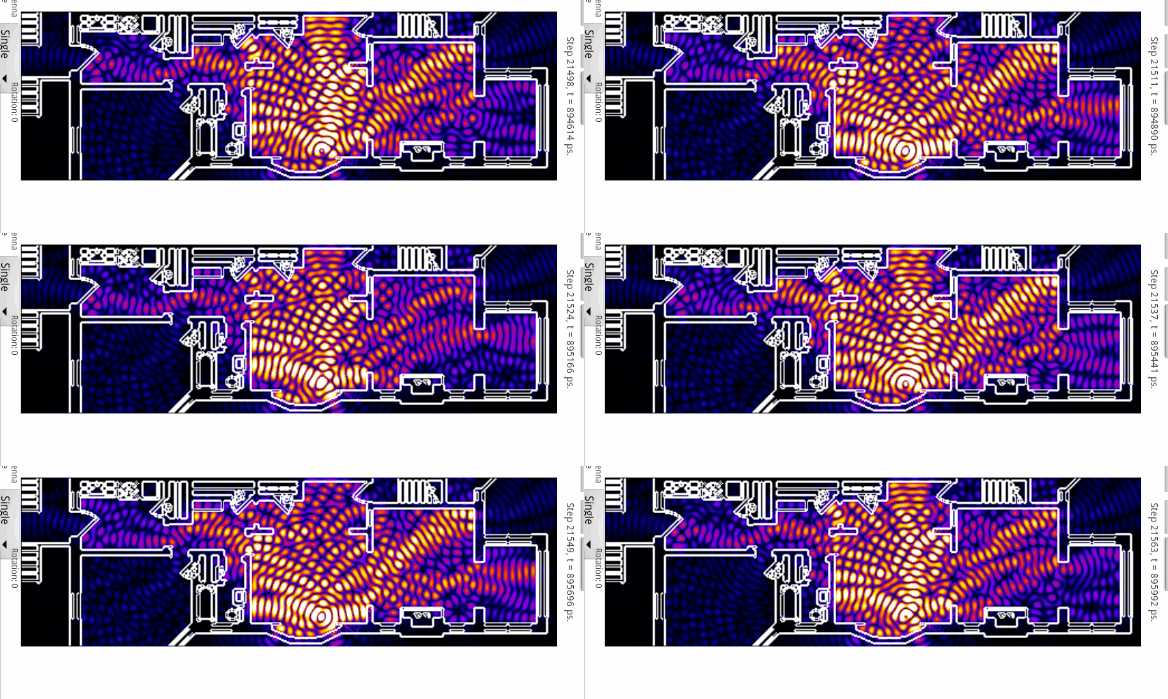
Gif found on https://electronics.stackexchange.com/a/144583
The Goldilocks Zone

Original image from: https://exoplanets.nasa.gov/what-is-an-exoplanet/how-do-we-find-habitable-planets/
So far I’ve said that introductory educational content shouldn’t be too simple, introduce concepts without explaining them, or focus too heavily on theory.
It can sometimes be difficult to find educational material which matches that criteria (and even more difficult to find it for free).
Ultimately, this is entirely subjective. Everyone has different experience which may lead them to having an easier time with some new concepts than others. One person’s “perfect” beginner resource might be utterly useless to someone else.
So why did you write a whole post just to say that it’s subjective?
Good question! Well, unfortunately that doesn’t change the sad truth that everyone will still have to perform the monotonous task of sifting through the landfill of information that is known as the internet.
In some cases it can be just as difficult to find actually useful information on a topic regardless of whether you’re a beginner or someone with more experience.
“One man’s trash is another man’s treasure”
- some old guy probably
Strategies to find better content
I’ve found that there are a few ways to consistently find high quality beginner resources that people may not immediately think of trying (beyond the outdated tips like: “use simple language!” and “remove punctuation!”).
- Find dedicated forums for the topic (search: “topic forum”, look for subreddits, etc.) and check for a “resources” or “frequently asked questions” section. Oftentimes there are entire wikis set up to help beginners get started on the topic at hand.
- Look for someone who seems to know what they’re doing, and ask them how you should get started. Twitter is great for this, most people are open to helping out as long as you’re respectful towards them and their time. And of course, make an attempt to look for information yourself before asking.
- Change search engines, or use incognito mode. It’s no secret that search engines tailor the results to the user, and in some cases the search engine might just be wrong about what you want to see.
In this case, the best introductory resource on radio I found was an episode of the TV show The Secret Life of Machines released in 1991. The video goes through the history, basic theory, and practicalities of the basic technology behind the radio, and does it well.
After watching that, I moved onto more complicated materials. After that I… (I’m sure you get the pattern)
But why is so much introductory content just bad?
Sometimes it’s not a case of “one man’s trash is another man’s treasure,” and the content is objectively bad (erroneous research, misleading visuals, etc.).
The amount of good educational content on the internet hasn’t scaled with the overall amount of content, and unfortunately the idea that the best will rise to the top does not always hold true.
The gems are out there, but they are often hidden.
This is a different kind of post than I’m used to. Admittedly it wasn’t as interesting to write as the more technically focused ones that I’ve done in the past, so I’ll probably stick to those in the future.